
By Scott Neill | Published: March 31, 2026 | Last Updated: July 2026
Quick Summary
This article, with insights from Neill Insurance Brokers, explains how Texas homeowners insurance deductibles work, highlighting the unique two-deductible system that separates wind and hail claims from other perils. It reveals how percentage-based deductibles can lead to unexpectedly high out-of-pocket costs and offers guidance on choosing a deductible that balances premium savings with financial protection.
Key Takeaways:
- Texas homeowners insurance includes two deductibles: a flat dollar amount for most claims and a percentage-based deductible for wind and hail damage.
- Percentage deductibles can result in thousands of dollars in out-of-pocket costs, especially on higher-valued homes, which many homeowners underestimate.
- Choosing a higher wind and hail deductible can lower premiums by $300 to $600 annually but may increase your claim costs by thousands of dollars.
- Evaluate your ability to pay deductibles after a storm to select a deductible that protects both your home and your finances effectively.
Having spent 10 years as a captive Farmers agent before founding Neill Insurance Brokers, Scott Neill has reviewed hundreds of North Texas homeowners policies. In 2026, Texas policies feature two deductibles to manage storm risks. Across his 304 active homeowner policies in North Texas—including 124 clients who followed him from the Farmers book—he always ensures clients understand that the Wind and Hail deductible is typically a percentage (1% to 3%) of your home’s value, while the All Other Perils (AOP) deductible is a flat dollar amount for fire or theft. This structure requires higher out-of-pocket payments for Texas’s frequent hailstorms.
Texas Homeowners Insurance Deductibles Explained, Why There Are Two
Most homeowners assume they have one deductible. In Texas, you actually have two, and they apply to completely different types of claims.
All Other Perils Deductible, Flat Dollar Amount
This deductible applies to everyday risks like fire, theft, vandalism, and certain types of water damage.
Common options include:
- $1,000
- $2,500
- $5,000
Wind and Hail Deductible, Percentage Based
This deductible applies to weather related claims, including hailstorms, wind damage, tornadoes, and hurricanes.
Instead of a flat number, it is based on a percentage of your home’s insured value.
Typical options:
- 1 percent
- 2 percent
What Your Percentage Deductible Actually Costs You
A percentage deductible sounds small, but the real impact becomes clear when you convert it into dollars.
Here is what that looks like in real terms:
- $300,000 home
- 1 percent equals $3,000
- 2 percent equals $6,000
- $400,000 home
- 1 percent equals $4,000
- 2 percent equals $8,000
- $500,000 home
- 1 percent equals $5,000
- 2 percent equals $10,000
This is where many homeowners realize they are far more exposed than they thought.
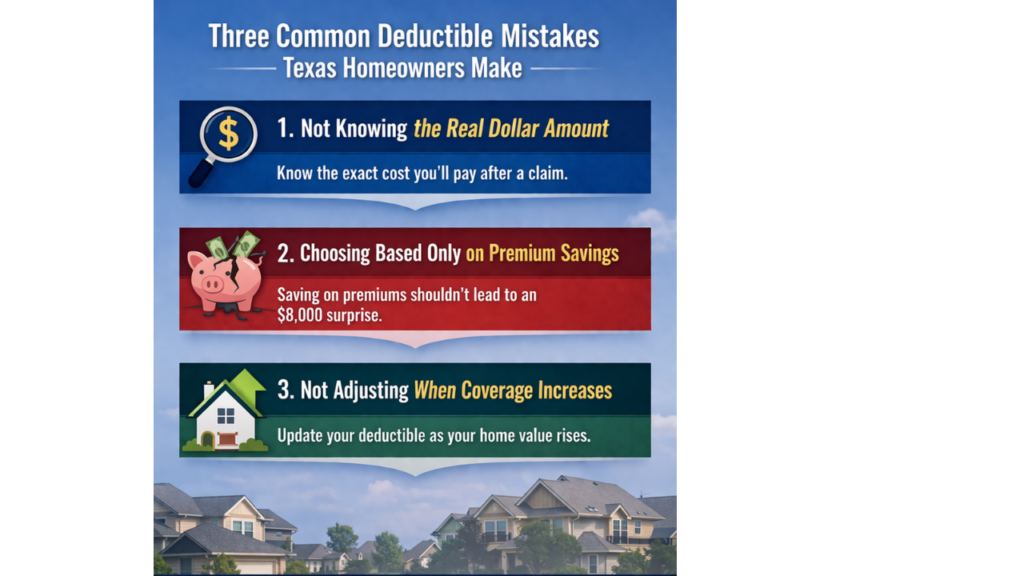
For example, if a hailstorm causes $7,000 in roof damage and your deductible is $8,000, your insurance pays nothing. You cover the full cost out of pocket.
The Real Trade Off, 1 Percent vs 2 Percent Wind and Hail Deductibles
Many homeowners choose a higher deductible to lower their premium. On the surface, that seems like a smart financial move.
But this is one of the most misunderstood decisions in homeowners insurance.
Switching from a 1 percent to a 2 percent deductible typically saves between $300 and $600 per year.
Over five years, that adds up to:
- $1,500 to $3,000 in savings
However, the out of pocket difference on a claim can be significant.
On a $400,000 home:
- 1 percent deductible equals $4,000
- 2 percent deductible equals $8,000
You are risking an additional $4,000 in a single claim to save a few hundred dollars per year.
Challenging the Common Assumption
Many people believe that choosing the highest deductible is always the most cost effective strategy.
That is not true if the deductible exceeds what you can comfortably pay.
Insurance is not just about saving money on premiums. It is about transferring risk. If your deductible is too high to realistically afford, you have not transferred the risk, you have simply delayed it.
The AOP Deductible, Simple But Still Strategic
Your All Other Perils deductible is more straightforward, but it still plays an important role in your financial protection.
Typical savings:
- Moving from $1,000 to $2,500 may save $100 to $200 per year
- Moving to $5,000 saves more, but increases your out of pocket responsibility
For most homeowners, the balance between affordability and protection lands at $1,000 or $2,500.
How to Choose the Right Deductible for Your Situation
Instead of guessing, use this simple framework:
- If you have strong emergency savings and want lower monthly costs, a higher deductible may make sense
- If paying a large out of pocket expense would create financial stress, a lower deductible is the safer choice
The right deductible is not the cheapest option, it is the one you can confidently afford when something goes wrong.
Frequently Asked Questions
What is a typical deductible for homeowners insurance in Texas?
Most homeowners have a $1,000 to $2,500 All Other Perils deductible and a 1 percent or 2 percent wind and hail deductible.
Why are wind and hail deductibles percentage based?
Insurance companies use percentage deductibles to manage the high volume of weather related claims in Texas, especially from hailstorms and hurricanes.
Can I change my deductible at any time?
In most cases, you can adjust your deductible at renewal or during a policy change. A review with your broker can help you evaluate your options.
How do I know if my deductible is too high?
If you would struggle to pay it after a claim, it is likely too high for your situation.
Make Sure Your Deductible Works for You
Choosing a homeowners insurance deductible can feel like a small decision, but it has a major impact when you actually need your policy.
If you have ever been unsure about what your deductible really means, you are not alone. Many Texas homeowners discover too late that their out of pocket costs are higher than expected, especially after a storm.
At Neill Insurance Brokers, we help homeowners review their coverage, compare deductible options, and understand exactly what they are responsible for before a claim happens.
If you want clarity and confidence in your coverage, request your free deductible analysis and get a personalized breakdown of your options.
